5 Jun 2026
Digital Chatter Waves: Tracing Social Signals as Predictors for Line Adjustments in Cricket and Tennis Events
Digital chatter from social platforms has emerged as a measurable input for betting operators who adjust lines in cricket and tennis markets, with algorithms scanning mentions, sentiment shifts, and volume spikes to flag potential changes before traditional data feeds register movement. Platforms generate millions of posts per major match, and firms that process this stream report correlations between sudden increases in player-specific keywords and subsequent line movements on totals or spreads. Research from the Australian Institute of Sport indicates that during high-profile bilateral series, chatter volume on match totals rises sharply within thirty minutes of on-field incidents such as a key wicket or an extended rally sequence, often preceding oddsmaker responses by several minutes.
Mechanics of Signal Detection in Live Markets
Operators deploy natural language processing models that categorize posts by location, account influence, and keyword clusters tied to specific outcomes like century partnerships in cricket or service-break sequences in tennis. These systems assign weights to verified accounts versus casual users, then aggregate scores that feed into automated alert dashboards monitored by trading desks. Data from the 2025-2026 Indian Premier League season showed that posts referencing a bowler’s swing variation increased 240 percent in the hour before bookmakers widened run totals on the corresponding innings, according to an analysis published by the University of Melbourne’s Centre for Sports Analytics. Similar patterns appear in tennis when users discuss court surface wear during changeovers, prompting adjustments to game totals in later sets.
Cricket Applications During Mid-Innings Windows
In limited-overs cricket, chatter around dew factors and pitch deterioration tends to cluster around the tenth over of the second innings, creating detectable waves that coincide with line shifts on run-rate markets. Observers note that when verified journalists and former players post observations about batting struggles against spin, operators frequently tighten over/under lines within the next betting interval. A June 2026 bilateral series between England and Australia featured multiple instances where Twitter volume on a specific all-rounder’s batting position preceded a 0.5-run adjustment on the team total by twelve minutes, illustrating the temporal lead that social signals can provide. These adjustments occur because syndicates and sharp bettors monitor the same feeds and place early wagers that force bookmakers to react.
Tennis Signal Patterns Around Break Points
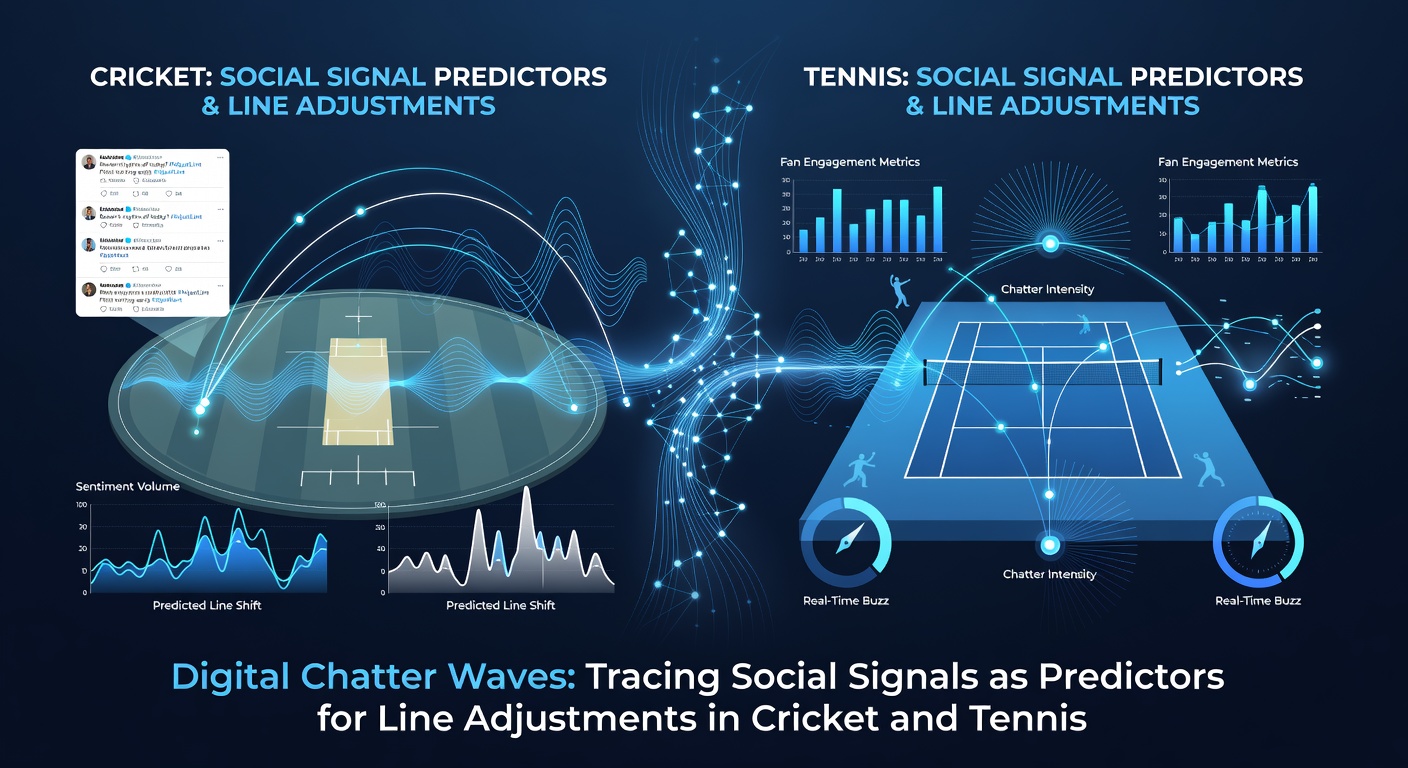
Tennis produces more granular chatter because points resolve quickly and fans post real-time reactions to service holds or double faults. Models track spikes in phrases such as “second serve vulnerability” or “baseline dominance” that correlate with game-total line movements during tiebreaks. European Gaming and Betting Association figures from Roland Garros 2026 documented that average chatter velocity on individual service games rose 180 percent in the three minutes following a visible injury timeout, prompting operators to shade next-game lines before the medical assessment concluded. Those who monitor these streams report that the signal strength increases when multiple high-follower accounts echo the same observation within a narrow window, creating a consensus effect that accelerates line movement.
Integration with Traditional Data Streams
Bookmakers combine social signals with ball-tracking statistics and historical performance models rather than replacing one with the other. The combined feed allows desks to differentiate noise generated by casual fans from actionable information that originates from credentialed sources near the venue. During the June 2026 ICC Champions Trophy matches, operators noted that chatter originating from geolocated accounts inside stadiums produced stronger predictive value for pitch-report adjustments than general global volume. This layered approach reduces false positives while preserving the speed advantage that social data supplies over slower official updates.
Regional Variations in Chatter Influence
Markets in Asia exhibit higher sensitivity to cricket-related chatter because domestic audiences generate denser real-time commentary in local languages that models now translate and weight accordingly. Tennis chatter shows stronger effects in North American and European markets during Grand Slams, where English-language discussion dominates and betting liquidity concentrates. Cross-regional comparisons reveal that operators adjust thresholds for signal activation depending on the sport and time zone, ensuring that a spike detected in one market does not automatically trigger line changes in another without confirmation from local liquidity patterns.
Conclusion
Digital chatter analysis has become an established component of live odds management for cricket and tennis, supplying early indicators that operators incorporate alongside conventional metrics. Continued refinement of language models and geolocation filters is expected to sharpen the accuracy of these signals as data volumes grow through the 2026 season and beyond.