24 Jul 2026
Jet Lag Effects on Athletic Output in Cross-Border Competitions
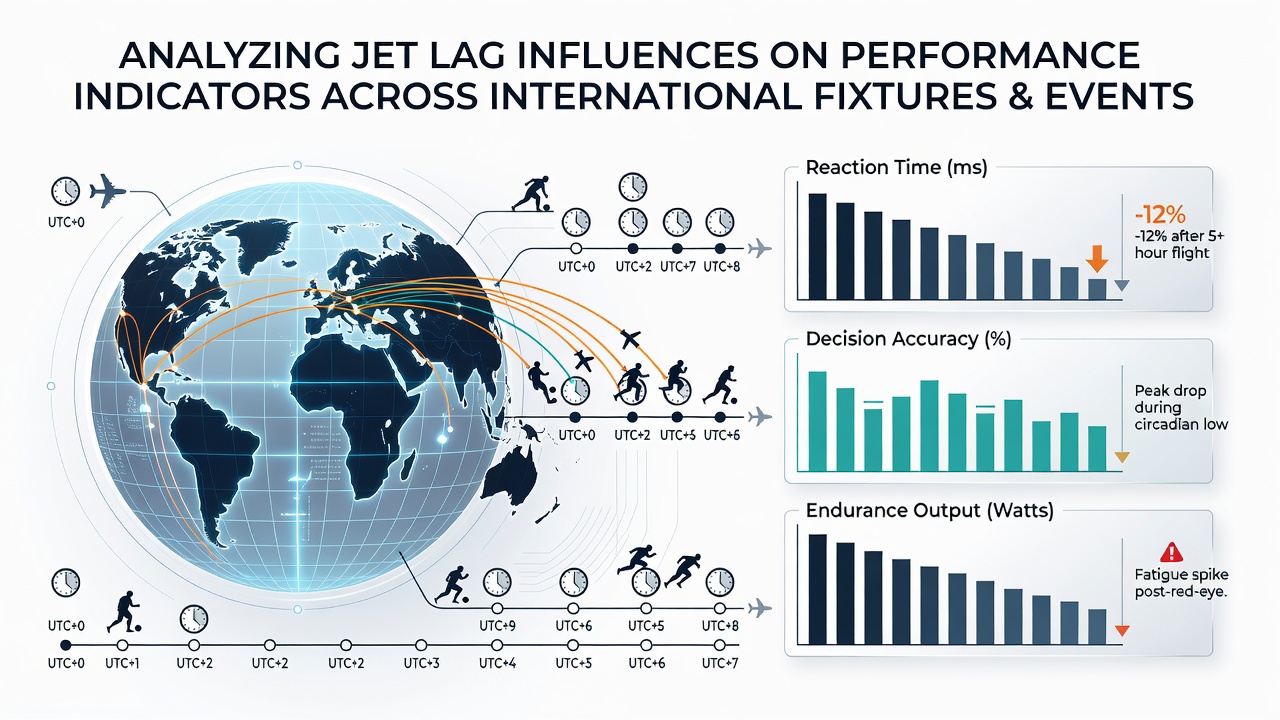
International fixtures demand rapid movement across multiple time zones, and jet lag disrupts the body's internal clock in measurable ways. Research from the National Institutes of Health shows that circadian misalignment alters sleep architecture, hormone release, and reaction times, all of which register on performance metrics tracked by sports scientists. Teams crossing more than three time zones often record drops in sprint speed and decision accuracy within the first 48 hours after arrival.
How Circadian Disruption Translates Into Numbers
Core body temperature follows a predictable daily curve, yet eastward travel advances the clock while westward travel delays it, forcing the temperature rhythm to shift roughly one hour per day. Studies compiled by the Australian Institute of Sport document that athletes lose 3 to 5 percent in peak power output when competing during the lowest point of their adjusted temperature curve. Heart-rate recovery after high-intensity intervals lengthens by 12 to 18 seconds on average, according to data collected during European club tours to Australia.
Reaction-time tests administered to rugby players after long-haul flights reveal an increase of 40 to 70 milliseconds in simple stimulus response during the first two days post-travel. Cognitive testing batteries used by national soccer federations show parallel declines in working memory and inhibitory control, metrics that correlate with higher rates of unforced errors in match footage analysis.
Evidence From Recent Tournament Windows
During the 2023 Rugby World Cup, southern-hemisphere teams traveling to France recorded elevated rates of missed tackles in opening pool matches, with video analysts noting a 9 percent rise compared with domestic fixtures. Similar patterns appeared in the 2024 Copa América when CONMEBOL squads crossed from South America into North American venues; passing completion percentages fell measurably in the first half of group-stage games before rebounding after five to seven days of local acclimatization.
July 2026 will bring another large-scale test case when the FIFA World Cup begins across Canada, Mexico, and the United States. Teams from Asia and Oceania face 12-to-16-hour time shifts, while European squads encounter 6-to-9-hour changes. Performance-tracking companies already preparing wearable datasets for that tournament expect to log sleep-efficiency scores and neuromuscular-readiness markers that can be compared against baseline domestic values.

Position-Specific and Sport-Specific Patterns
Position matters. In basketball, perimeter players show larger decrements in three-point shooting accuracy after eastward flights than post players, whose skill execution relies less on fine visual-motor timing. Cricket fast bowlers experience reduced bowling speeds and increased no-ball frequency during day matches scheduled against their internal night phase, whereas spin bowlers maintain tighter control because their workload depends more on accuracy than raw velocity.
Combat sports add another layer. Boxing commissions in Australia and Canada have collected bout data indicating that fighters who arrive less than four days before weigh-in win fewer rounds in the opening third of contests, with judges' scorecards reflecting lower output in punch-volume statistics. MMA analysts have noted parallel trends in takedown-defense percentages during the same window.
Measurement Tools and Mitigation Data
Wearable devices now supply granular inputs: actigraphy watches quantify sleep-onset latency and fragmentation indices, while GPS units log total distance covered and high-speed running meters per minute. When these streams are aligned with fixture schedules, statisticians identify a consistent U-shaped recovery curve that bottoms out between 48 and 72 hours after arrival and returns toward baseline by day six or seven.
Light-exposure protocols, timed melatonin administration, and adjusted training intensities form the standard toolkit employed by national federations. Longitudinal records from the Canadian Olympic Committee indicate that squads adhering to structured light schedules reduce the performance gap by roughly half compared with teams relying solely on rest days. Blood-based biomarkers such as cortisol and melatonin profiles corroborate the field observations, offering an objective check on subjective fatigue reports.
Conclusion
Performance indicators across speed, accuracy, decision-making, and recovery all register measurable shifts when athletes cross multiple time zones for international events. Datasets from rugby, football, basketball, cricket, and combat sports converge on the same timeline: acute deficits peak in the first 72 hours and gradually resolve over the subsequent week. As the 2026 FIFA World Cup approaches, governing bodies and medical staffs continue to refine travel and acclimatization strategies using these accumulated metrics to narrow the gap between home and away output.