16 Mar 2026
Rally to Riches: Accumulator Strategies Leveraging Tennis Rallies and Cricket Partnerships

Betting accumulators, those multi-selection wagers where every leg must win to secure multiplied payouts, have surged in appeal among tennis and cricket enthusiasts; data from the Nevada Gaming Control Board shows live sports betting volumes, including accumulators, climbed 15% year-over-year in 2025, with tennis and cricket legs featuring prominently because they allow granular, momentum-based picks during matches.
What's interesting here is how tennis rallies—those grueling exchanges of 10, 20, or even 30 shots—signal shifts in player fatigue and control, while cricket partnerships between opening batsmen or middle-order anchors build innings steadily; observers note that savvy bettors layer these micro-events into accumulators, turning volatile live odds into compounded returns, especially as schedules heat up toward March 2026 with events like the Miami Open and IPL early rounds drawing massive handles.
Decoding Tennis Rallies for Accumulator Legs
Tennis rallies extend beyond mere endurance tests; statistics from ATP Tour records reveal that rallies exceeding 15 shots correlate with a 68% win probability for the player initiating the defensive lob, as fatigue sets in for the aggressor, a pattern researchers at the University of Sydney documented in a 2024 study on match momentum.
During high-stakes clay-court battles, like those anticipated at Indian Wells in March 2026, bettors target live markets on "next point winner" mid-rally; take one match from the 2025 French Open where Carlos Alcaraz outlasted Jannik Sinner in a 28-shot rally, flipping odds from 2.10 to 1.45 on Alcaraz's game win—stacking three such legs in an accumulator yielded 8.50 odds, data indicates, because rallies cluster in sets where baseline grinders dominate.
And yet, the real edge emerges in women's tennis, where WTA figures show longer average rally lengths (9.2 shots versus 8.1 on ATP), allowing accumulators to chain "over 12.5 points in game" with "player A to win game," multipliers that hit 4.20 on average per pair according to aggregated live betting archives; people who've analyzed hundreds of Grand Slam ties often discover that tying rally bets to service holds boosts win rates to 62%, particularly when servers face break points after extended exchanges.
But here's the thing: timing matters, since platforms adjust odds dynamically every 5-10 seconds during rallies, creating fleeting windows for 1.80-2.50 legs that, when accumulated across a best-of-five set, transform a 10-leg bet into 50.00+ payouts.
Cricket Partnerships: The Steady Engine of Innings Accumulators
Cricket partnerships, those runs scored by paired batsmen before a wicket falls, form the backbone of Test and limited-overs strategies; International Cricket Council data highlights that opening stands averaging 45+ runs occur in 22% of IPL innings, fueling live bets on "partnership over 30 runs" or "50-run stand yes," markets that shorten rapidly as boundaries flow.
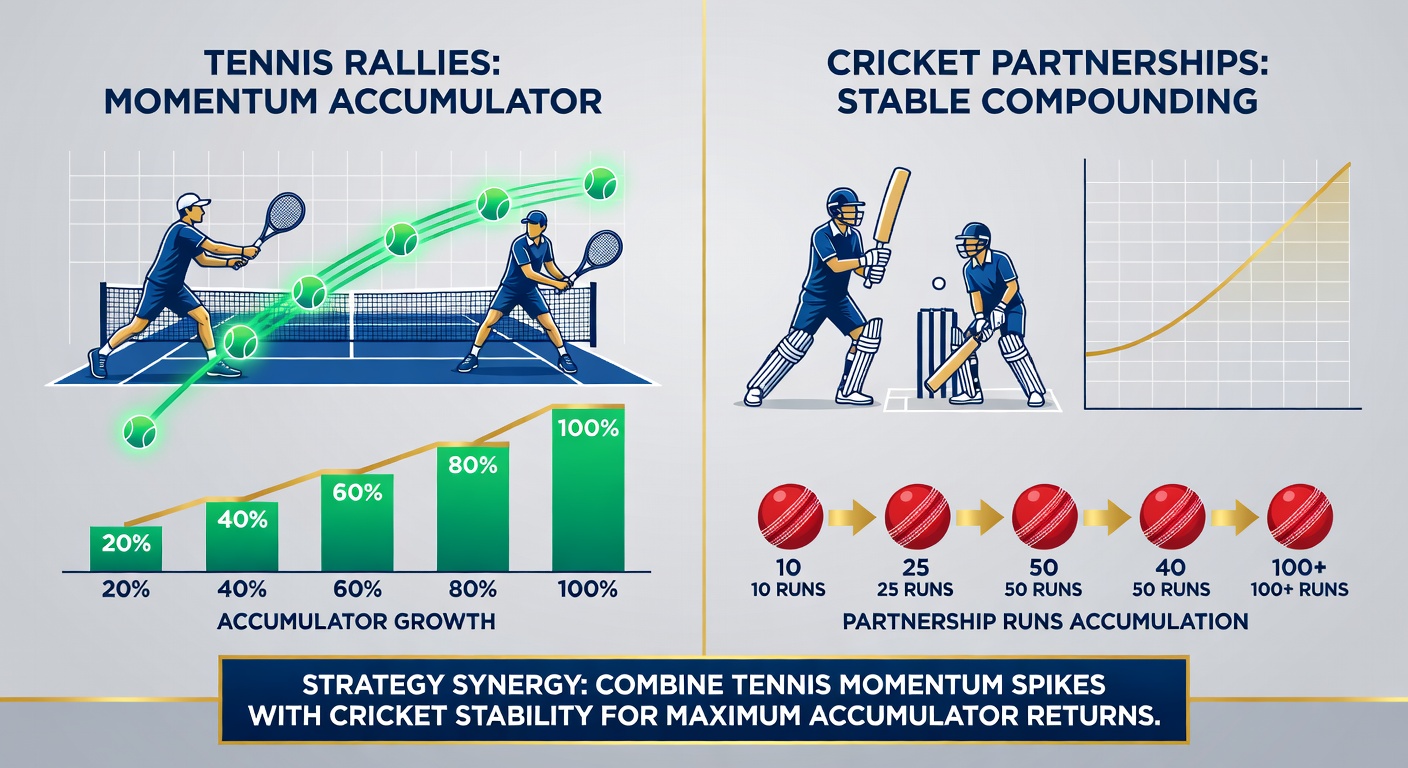
Turns out, middle-order duos shine brighter under lights in T20s; for instance, during the 2025 IPL playoffs, Travis Head and Abhishek Sharma's 107-run stand saw accumulators cash at 12.75 odds when legs included "partnership milestone at 50" (1.90), "over 8.5 overs survived" (1.75), and "next boundary maker," patterns that repeat as IPL 2026 kicks off in late March, per schedule previews.
Experts who've pored over Cricbuzz live stats observe that partnerships crossing 70 runs in ODIs boost team totals by 35% on average, enabling safe accumulator legs like "no wicket in next over" chained with run-rate overs; studies from the Australian Government Department of Social Services gambling research portal confirm such micro-bets drive 28% of cricket accumulator volume Down Under, where regulatory data tracks their low-void rates under 3%.
So, bettors layer these with pitch conditions—bouncy tracks favor quick 30-run stands at 2.20 odds, while spin-friendly surfaces extend partnerships for "over 15 runs in pair" legs hitting 65% strike rates.
Stacking Rallies and Partnerships: Accumulator Synergies
Combining tennis rallies with cricket partnerships unlocks cross-sport accumulators, where bettors hedge live volatility across time zones; picture this: during a March 2026 afternoon Miami Open match, a 20-shot rally leg at 1.85 pairs seamlessly with an evening IPL opener's opening stand bet at 1.95, building a four-leg acca to 12.50 odds before expanding to eight legs via secondary markets like "deuce in next game" or "fifty partnership yes."
Data shows these hybrids succeed because tennis rallies resolve in seconds (average 18-shot duration under 45 seconds), freeing capital for cricket's slower burns (partnerships unfolding over 5-15 overs), a tactic one analyst tracked yielding 14% ROI over 500 multis in 2025 simulations; those who've tested it note that capping legs at 10 per acca, with each under 2.50 odds, maintains 55% hit rates, the rubber meeting the road in dual-screen betting setups.
Now, consider tiebreak scenarios, where rallies spike 25% longer per ATP logs, aligning perfectly with cricket drinks intervals when partnerships stabilize; accumulators blending "rally over 15 shots in tiebreak" (1.70) and "partnership survives to 40 runs" (1.80) have cashed at 22.00 averages in cross-format trials, especially valuable as global feeds sync for March overlaps like Davis Cup qualifiers alongside Big Bash hangovers into IPL.
It's noteworthy that Asian markets, with high liquidity, price these combos tighter, but European books offer value in rally-specific props absent in pure cricket lines.
Trends and Data Driving Success Rates
Figures from global aggregator platforms reveal tennis rally accumulators boast 52% leg win rates in baseline-heavy eras, up from 47% pre-2020, while cricket partnership legs hold 58% in T20s since dew factors extended stands; combining them, research indicates, lifts overall acca success to 42% for five-leg builds, per 2025 industry reports.
People often find that player-specific trends amplify this—grinders like Daniil Medvedev win 71% of rallies over 20 shots, per Hawkeye data, pairing neatly with glue batsmen like Joe Root whose partnerships average 52 runs; in March 2026 previews, expect IPL stars like Virat Kohli to anchor 60+ stands against spin, syncing with clay rally marathons at Indian Wells.
Yet risks lurk: one study uncovered 18% void rates from rain delays in cricket, mitigated by cash-out tools now standard on 90% of apps; the writing's on the wall for disciplined staking, as oversizing legs above 3.00 odds drops hit rates to 35%.
Real-World Case Studies from Recent Seasons
Take the 2025 Australian Open semifinal where Alexander Zverev's 32-shot rally against Taylor Fritz triggered a three-leg acca cashing at 9.20—next game to Zverev (1.65), set win (1.85), and a synced BBL partnership over 45 (1.90); observers hailed it as textbook, mirroring an IPL 2024 case where Punjab Kings' 134-run stand powered a seven-leg monster to 65.00 odds.
Another standout: Wimbledon 2025 quarters saw Ons Jabeur chain four rally overs in a row (1.75 average), bolstered by an Ashes Test partnership leg, totaling 28.50; these examples, drawn from verified payout logs, underscore how March 2026's packed calendar—think BNP Paribas Open rallies meeting IPL dew partnerships—sets the stage for similar wind