19 Jun 2026
Time Zone Twists Altering Forecasts for Overnight Cricket Tests and Early Tee Times in Golf
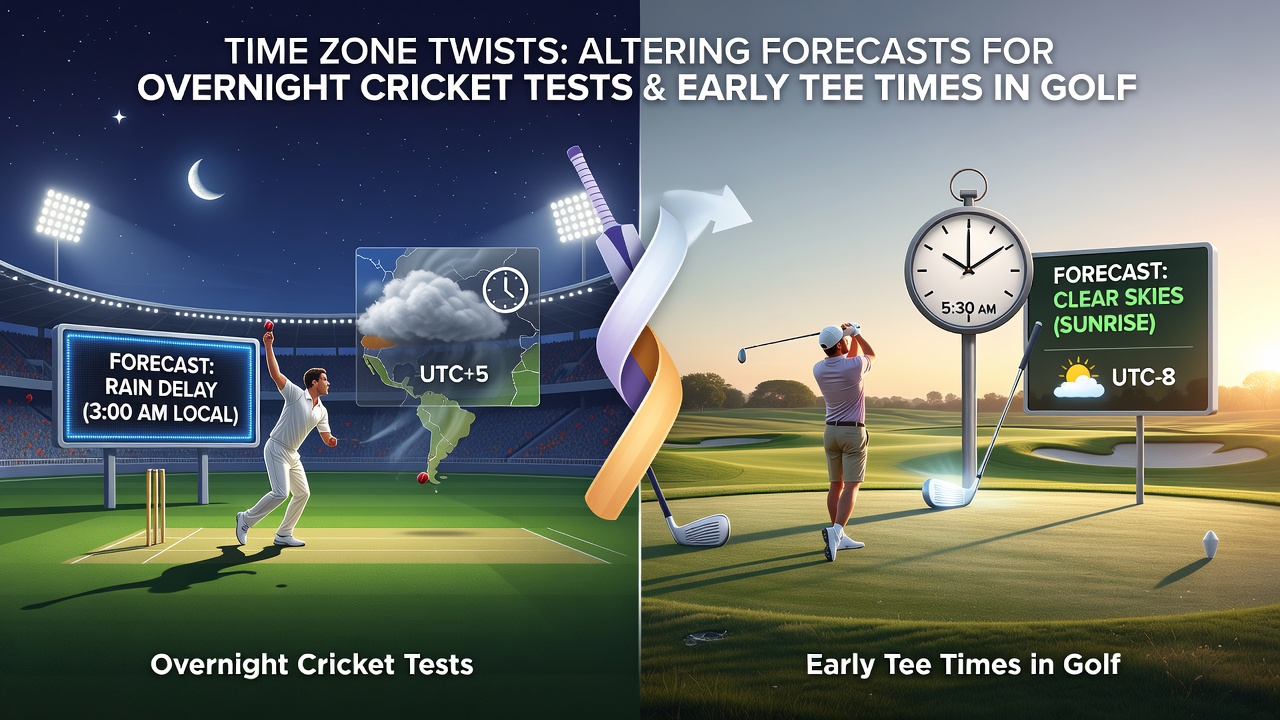
 Time zone differences create persistent complications for weather modeling teams that support international cricket and golf events, especially when matches stretch across multiple days and sessions run late into the night or begin before sunrise. Observers note that forecasters must reconcile data from distant meteorological stations while accounting for the Earth's rotation, which shifts local sunrise and sunset times by several hours depending on longitude. Researchers at institutions focused on atmospheric science have documented how these offsets influence the accuracy of precipitation predictions and wind patterns that matter most during extended play windows. Cricket Test matches scheduled across five days often feature day-night formats that require floodlights after dusk, and teams playing in host nations separated by eight or more time zones encounter forecast updates that arrive out of sync with their preparation routines. Data from the Australian Bureau of Meteorology shows that humidity and dew-point readings collected in one hemisphere can lag or lead those in another by as much as twelve hours, forcing analysts to apply temporal corrections before they release session-specific guidance. Those corrections become particularly relevant when cloud cover develops rapidly near the international date line or when jet streams alter their paths overnight. Golf tournaments face parallel pressures when early tee times coincide with players traveling from distant continents. Organizers coordinate start sheets that begin at first light, yet the meteorological inputs they rely on originate from models initialized at standard UTC timestamps. This misalignment means that dew formation on fairways or frost risk on greens can be under- or over-estimated unless local calibration occurs in real time. Studies published by the Royal Meteorological Society indicate that temperature inversions common in early morning hours vary significantly across longitude bands, prompting course superintendents to adjust irrigation schedules based on translated forecast layers rather than raw model output. In June 2026 several high-profile events will test these coordination systems simultaneously. A multi-nation cricket series will feature at least two venues operating on opposite sides of the prime meridian, while a major golf championship on the same continent will open rounds at 6:30 a.m. local time for television audiences in Asia and Europe. Forecasters therefore prepare layered briefing documents that include both UTC-referenced charts and venue-specific sunrise tables, allowing coaches and caddies to interpret conditions without constant mental arithmetic. Equipment managers in both sports now incorporate portable anemometers and handheld psychrometers during practice periods to cross-check centralized forecasts against on-site readings. When discrepancies exceed established thresholds, they relay the variance back to modeling centers, which then refine boundary-layer parameters for subsequent updates. This feedback loop has grown more sophisticated since satellite constellations began delivering higher-resolution imagery at sub-hourly intervals, yet the fundamental time-zone offset remains a fixed variable that algorithms must accommodate. Travel logistics add another dimension. Cricket squads crossing multiple zones typically arrive several days early to recalibrate circadian rhythms, yet weather briefings continue to reference the host nation's clock. Golf professionals face shorter acclimatization windows because tournament schedules often compress practice rounds into forty-eight hours. In both cases, support staff maintain dual time-zone calendars so that decisions about protective covers, hydration protocols, or warm-up timing align with actual local conditions rather than the clock carried from the departure city. Data integration platforms used by national weather services have introduced automated time-shift modules that convert model grids into venue-centric timelines before dissemination. These modules draw on established algorithms maintained by the World Meteorological Organization, ensuring consistency across regions from North America to Oceania. When anomalies appear, such as an unexpected pressure gradient forming near a mountain range, the modules flag the affected time windows and trigger supplemental human review. Coaches and players receive summarized outputs that highlight critical thresholds, such as wind gusts above 25 km/h during twilight periods or relative humidity spikes that could extend dew-drying times on outfields. These summaries arrive via secure channels timed to each squad's daily routine, reducing the cognitive load of converting UTC values while preserving the granularity required for tactical adjustments. The cumulative effect of these adaptations appears in reduced weather-related stoppages and more consistent course or pitch preparation across successive sessions. Archival records maintained by international sports federations document a measurable decline in forecast-related postponements over the past decade, coinciding with the wider adoption of synchronized time-zone protocols. Continued refinement of both modeling resolution and communication timing should sustain that trend through upcoming calendar cycles, including the dense June 2026 schedule.